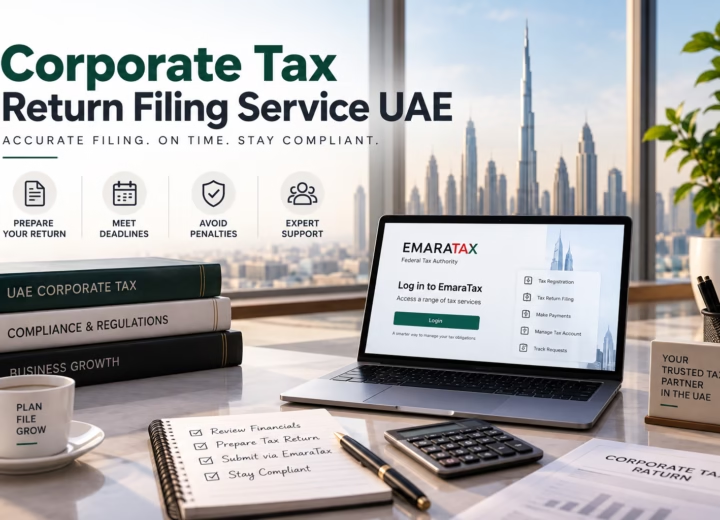
The introduction of Corporate Tax in the UAE has changed the way businesses manage their financial and regulatory obligations. While Free Zone companies continue to enjoy attractive tax benefits, many business owners mistakenly believe that they are automatically exempt from Corporate Tax compliance. In reality, most Free Zone businesses are still required to register for Corporate Tax, maintain proper accounting records, and file annual tax returns with the Federal Tax Authority (FTA).
Whether you operate in IFZA, Meydan Free Zone, DMCC, DAFZA, SHAMS, RAKEZ, SPC Free Zone, or any other UAE Free Zone, understanding the latest Corporate Tax rules is essential to protect your business from penalties and ensure continued eligibility for tax benefits.
If you need assistance with Corporate Tax registration, return filing, or compliance, Raes Associates offers end-to-end Corporate Tax services for businesses across all UAE Free Zones. Our experienced tax professionals help businesses remain fully compliant while maximizing available tax benefits.
Table of Contents
ToggleWhat Is Corporate Tax for UAE Free Zone Companies?
Corporate Tax is a direct tax imposed on the taxable profits of businesses operating in the UAE. It came into effect for financial years beginning on or after 1 June 2023 under the UAE Corporate Tax Law.
Free Zone companies often receive special tax treatment, but this does not mean they are automatically exempt from Corporate Tax obligations. Instead, they must determine whether they qualify for the 0% Corporate Tax rate available to certain businesses that meet specific conditions.
Even if your company qualifies for the 0% rate, you are generally still expected to:
- Register for Corporate Tax
- Maintain proper accounting records
- File Corporate Tax returns
- Comply with transfer pricing rules where applicable
- Meet all Federal Tax Authority requirements
Failure to comply can lead to financial penalties and may also result in losing valuable Free Zone tax benefits.
Free Zone corporate tax rules form part of the UAE’s broader corporate tax framework. Learn more in UAE Corporate Tax 2026 – Complete Guide.
Do Free Zone Companies Need to File Corporate Tax Returns?
Yes. One of the biggest misconceptions among Free Zone businesses is that no filing is required because they operate in a tax-friendly jurisdiction.
In reality, most Free Zone companies are required to comply with Corporate Tax regulations, even if no Corporate Tax is payable.
Generally, businesses must:
- Register with the Federal Tax Authority
- Obtain a Corporate Tax Registration Number
- File annual Corporate Tax returns
- Maintain supporting financial records
- Submit accurate financial information within the prescribed deadlines
The Corporate Tax return allows the FTA to determine whether a company qualifies for tax relief, whether Corporate Tax is payable, and whether the business has complied with UAE tax regulations. Simply operating in a Free Zone does not remove these obligations.
If you are unsure whether your company is required to register or when registration must be completed, read our detailed guide on who needs to register for UAE Corporate Tax and the applicable registration deadlines before proceeding with your tax filing.
What Is a Qualifying Free Zone Person (QFZP)?
One of the most important concepts under the UAE Corporate Tax regime is the Qualifying Free Zone Person (QFZP).
A Qualifying Free Zone Person is a Free Zone business that satisfies specific conditions laid down under the Corporate Tax regulations. Businesses that meet these conditions may continue to benefit from a 0% Corporate Tax rate on qualifying income.
To qualify, businesses generally need to:
- Maintain adequate economic substance in the UAE
- Earn qualifying income as defined under the regulations
- Comply with transfer pricing rules
- Maintain audited financial statements where required
- Meet the de minimis requirements for non-qualifying income
- Continue complying with all Corporate Tax filing requirements
If a business fails to meet any of these conditions, it may lose its QFZP status and become subject to the standard Corporate Tax rate on taxable income.
Because the eligibility criteria can be complex, many businesses seek professional guidance to determine whether they qualify.
UAE Free Zone Corporate Tax Rates (2026)
The Corporate Tax rate applicable to a Free Zone company depends on its tax status and the type of income it earns.
Business Category | Corporate Tax Rate | |
Qualifying Free Zone Person (Qualifying Income) | 0% | |
Non-Qualifying Income | 9% | |
Taxable Income up to AED 375,000 (where applicable) | 0% | |
Taxable Income above AED 375,000 | 9% | |
Large Multinational Groups (subject to DMTT rules) |
|
It is important to understand that not all income earned by a Free Zone company automatically qualifies for the 0% rate. Income from certain mainland transactions or non-qualifying activities may be taxed differently depending on the circumstances.
Proper tax planning and accurate classification of business activities play an important role in maintaining compliance.
Understanding the applicable Free Zone corporate tax rates is only part of the picture. Read How Can a Company Achieve a 0% Corporate Tax Rate in the UAE? to learn the conditions businesses must meet to qualify.
Which Free Zone Businesses Must File Corporate Tax?
Corporate Tax filing requirements apply to businesses operating across various UAE Free Zones.
This includes companies established in:
- Meydan Free Zone
- International Free Zone Authority (IFZA)
- Dubai Multi Commodities Centre (DMCC)
- Dubai Airport Free Zone (DAFZA)
- Sharjah Media City (SHAMS)
- Ras Al Khaimah Economic Zone (RAKEZ)
- Sharjah Publishing City (SPC Free Zone)
- Jebel Ali Free Zone (JAFZA)
- Dubai South
- Abu Dhabi Global Market (ADGM)
- Dubai International Financial Centre (DIFC)
Regardless of the Free Zone where your company is registered, you should determine whether:
- Corporate Tax registration is required
- Your company qualifies as a Qualifying Free Zone Person
- Your income includes both qualifying and non-qualifying income
- You are required to submit annual Corporate Tax returns
Businesses should avoid assuming that every Free Zone follows identical tax treatment, as eligibility depends on both the business activity and compliance with Corporate Tax regulations.
Why Corporate Tax Compliance Matters for Free Zone Businesses
Maintaining Corporate Tax compliance is about much more than avoiding penalties. Proper compliance helps protect the long-term benefits that make UAE Free Zones attractive to investors.
Some of the key advantages include:
Legal Compliance
Following Corporate Tax regulations helps businesses operate legally and confidently while meeting all FTA requirements.
Maintaining Tax Benefits
Qualifying Free Zone Persons may continue enjoying the 0% Corporate Tax rate only if they satisfy all ongoing compliance obligations.
Better Banking Relationships
Banks increasingly review Corporate Tax compliance when assessing corporate banking applications, financing requests, and due diligence checks.
Improved Business Reputation
Investors, suppliers, and international partners often prefer working with businesses that maintain accurate financial records and comply with UAE tax regulations.
Business Growth
Strong financial reporting and tax compliance create a solid foundation for expansion, fundraising, mergers, and cross-border business activities.
Corporate Tax Filing Deadlines for UAE Free Zone Companies
Meeting filing deadlines is one of the most important Corporate Tax responsibilities.
Generally, businesses must submit their Corporate Tax return within nine months after the end of their financial year.
For example:
Financial Year End | Corporate Tax Filing Deadline | ||||||||
|
|
The same deadline generally applies to both filing the Corporate Tax return and paying any Corporate Tax due.
Missing the filing deadline may result in administrative penalties, interest, and additional compliance issues with the Federal Tax Authority.
Businesses should prepare their financial statements well in advance, review their tax position carefully, and ensure all required documentation is ready before the filing deadline.
Documents Required for Corporate Tax Filing
Preparing the correct documentation before filing your Corporate Tax return can make the process much smoother and help avoid delays or errors. Since the Federal Tax Authority (FTA) may request supporting records during a review or audit, businesses should maintain complete and accurate documentation throughout the financial year.
Common documents required for Corporate Tax filing include:
- Trade License
- Corporate Tax Registration Number (TRN)
- Financial Statements
- Trial Balance
- General Ledger
- Profit and Loss Statement
- Balance Sheet
- Sales invoices and purchase records
- Bank statements
- Expense records
- Fixed asset register
- Payroll records (if applicable)
- Audited Financial Statements (where required)
- Transfer Pricing documentation (if applicable)
Keeping these records organized not only simplifies the filing process but also helps demonstrate compliance if your business is selected for an FTA review.
Step-by-Step Corporate Tax Filing Process for Free Zone Companies
Filing a Corporate Tax return involves more than simply submitting financial figures. Businesses must carefully assess their tax position, prepare accurate records, and ensure that all information submitted to the FTA is complete and correct.
Step 1: Register for Corporate Tax
Before filing your first Corporate Tax return, your business must complete Corporate Tax registration through the FTA’s EmaraTax portal.
During registration, you will receive a Corporate Tax Registration Number, which will be used for future tax filings and communications with the FTA.
Step 2: Determine Your Tax Status
The next step is identifying your Corporate Tax position.
Your business should determine:
- Whether it qualifies as a Qualifying Free Zone Person (QFZP)
- Whether it earns qualifying income
- Whether any non-qualifying income is taxable
- Whether additional reporting obligations apply
Understanding your tax status early helps prevent filing mistakes later.
Step 3: Prepare Your Financial Statements
Accurate financial statements form the foundation of every Corporate Tax return.
Businesses should ensure that:
- Revenue is properly recorded
- Business expenses are accurately classified
- Assets and liabilities are correctly reported
- Supporting documentation is available
Some businesses may also require audited financial statements depending on applicable regulations.
Step 4: Calculate Taxable Income
Once financial records are finalized, taxable income must be calculated according to the UAE Corporate Tax Law.
This process may include:
- Reviewing accounting profits
- Applying allowable tax adjustments
- Identifying exempt income
- Considering deductible expenses
- Calculating final taxable income
Businesses should avoid relying solely on accounting profit, as taxable income may differ after tax adjustments.
Step 5: Separate Qualifying and Non-Qualifying Income
This step is particularly important for Free Zone businesses.
Income should be reviewed carefully to determine:
- Income eligible for the 0% Corporate Tax rate
- Income subject to the standard Corporate Tax rate
- Transactions requiring additional disclosure
Proper classification helps maintain eligibility for Free Zone tax benefits.
Step 6: Complete the Corporate Tax Return
Once all financial information has been reviewed, businesses can complete their Corporate Tax return through the EmaraTax portal.
Before submission, verify:
- Company information
- Financial figures
- Tax calculations
- Supporting schedules
- Required declarations
Even small mistakes can delay processing or trigger additional reviews.
Step 7: Submit the Return and Pay Corporate Tax
After reviewing the return, submit it through the EmaraTax portal before the applicable deadline.
If Corporate Tax is payable, payment should also be made before the due date to avoid penalties.
Businesses should keep copies of:
- Filed returns
- Payment confirmations
- Supporting documents
- FTA acknowledgements
These records may be required during future compliance reviews.
Common Corporate Tax Filing Mistakes Free Zone Businesses Should Avoid
Many businesses encounter compliance issues simply because they misunderstand the Corporate Tax rules or overlook key filing requirements.
Some of the most common mistakes include:
Assuming Free Zone Companies Are Automatically Tax Exempt
Many businesses incorrectly believe that operating in a Free Zone eliminates all Corporate Tax obligations. In reality, registration and filing requirements still apply in most cases.
Missing Registration or Filing Deadlines
Late registration and delayed return submission can result in administrative penalties and unnecessary compliance issues.
Creating a tax calendar helps businesses stay on schedule.
Incorrect Business Activity Classification
Choosing the wrong business activity or misunderstanding qualifying income rules may affect eligibility for the 0% Corporate Tax rate.
Businesses should regularly review whether their activities continue to satisfy Free Zone requirements.
Poor Bookkeeping Practices
Incomplete accounting records make it difficult to prepare accurate Corporate Tax returns.
Businesses should maintain:
- Sales records
- Purchase records
- Expense documentation
- Bank reconciliations
- Payroll records
Good bookkeeping supports both compliance and better financial decision-making.
Ignoring Transfer Pricing Requirements
Businesses that engage in related-party transactions may need to comply with UAE transfer pricing regulations.
Ignoring these requirements could result in additional scrutiny during tax reviews.
Failing to Maintain Supporting Documents
The FTA may request evidence supporting information reported in a Corporate Tax return.
Businesses should retain all relevant accounting records, invoices, contracts, and financial documents for the required retention period.
Filing Incorrect or Incomplete Returns
Errors in tax calculations, omitted income, or incomplete disclosures may lead to penalties or requests for additional information.
Reviewing the return carefully before submission helps reduce unnecessary risks.
Penalties for Non-Compliance
The UAE Corporate Tax regime includes administrative penalties for businesses that fail to comply with their obligations.
Although the exact penalty depends on the nature of the violation, businesses may face consequences for:
- Failing to register for Corporate Tax
- Missing Corporate Tax filing deadlines
- Late payment of Corporate Tax
- Maintaining inadequate accounting records
- Providing incorrect information
- Failure to submit requested documentation during FTA reviews
Beyond financial penalties, non-compliance may also affect a company’s ability to maintain Qualifying Free Zone Person (QFZP) status, potentially resulting in higher Corporate Tax liabilities.
For this reason, businesses should establish strong internal accounting processes, monitor filing deadlines, and seek professional advice whenever necessary to ensure ongoing compliance.
Best Practices to Stay Corporate Tax Compliant
Corporate Tax compliance is not just about filing a return once a year. Businesses should adopt good financial and operational practices throughout the year to reduce compliance risks and make tax filing easier.
Maintain Accurate Accounting Records
Keep your financial records updated regularly instead of waiting until the filing deadline. Accurate bookkeeping helps you calculate taxable income correctly and provides the documentation required if the Federal Tax Authority (FTA) requests additional information.
Separate Qualifying and Non-Qualifying Income
Free Zone businesses should clearly distinguish between qualifying and non-qualifying income. Proper classification helps preserve Qualifying Free Zone Person (QFZP) status and ensures the correct Corporate Tax treatment.
Monitor Filing Deadlines
Missing Corporate Tax deadlines can result in penalties and unnecessary complications. Businesses should maintain a compliance calendar to track important dates for registration, return filing, and tax payments.
Review Business Activities Regularly
As businesses grow, they often add new products, services, or markets. These changes may affect Corporate Tax obligations or eligibility for Free Zone tax benefits. Conducting regular reviews helps identify any compliance issues before they become costly.
Maintain Supporting Documents
Keep invoices, contracts, bank statements, payroll records, financial statements, and other supporting documents organized and easily accessible. Proper documentation simplifies tax filing and supports your business during FTA reviews or audits.
Seek Professional Tax Advice
Corporate Tax regulations continue to evolve, and understanding the latest requirements can be challenging. Working with experienced tax professionals helps businesses remain compliant while reducing the risk of errors.
Choosing an FTA-registered tax agent can help ensure accurate tax filings, regulatory compliance, and expert guidance tailored to your business. Learn more in Corporate Tax & VAT: Why You Should Choose an FTA Registered Tax Agent.
Why Professional Corporate Tax Support Matters
Although many businesses attempt to manage Corporate Tax filings internally, professional guidance can help avoid costly mistakes and improve compliance.
Professional support can assist with:
- Corporate Tax registration
- Determining QFZP eligibility
- Preparing financial statements
- Calculating taxable income
- Preparing and filing Corporate Tax returns
- Transfer pricing documentation
- Corporate Tax advisory services
- Ongoing compliance support
Businesses with multiple activities, international transactions, or operations across different jurisdictions often benefit from expert advice to ensure they meet all regulatory requirements.
To better understand the UAE corporate tax system, read How Corporate Tax Works in Dubai | UAE Tax Explained 2026 before seeking professional tax support.
Need Help with UAE Free Zone Corporate Tax Filing?
Corporate Tax compliance has become an essential part of running a business in any UAE Free Zone. Whether your company qualifies for the 0% Corporate Tax rate or is subject to the standard Corporate Tax rate, timely registration, accurate record-keeping, and proper return filing are critical to avoiding penalties and maintaining compliance.
If you are unsure about your filing obligations, Qualifying Free Zone Person (QFZP) status, or Corporate Tax calculations, professional guidance can make the process much easier.
Raes Associates provides comprehensive Corporate Tax services for businesses across all UAE Free Zones, including Corporate Tax registration, return preparation, filing, accounting support, tax advisory, and ongoing compliance assistance. Contact Raes Associates today to ensure your business meets every Corporate Tax requirement with confidence.
Frequently Asked Questions
Do Free Zone companies need to file Corporate Tax returns?
Yes. Most UAE Free Zone companies are required to register for Corporate Tax and file annual Corporate Tax returns, even if they qualify for the 0% Corporate Tax rate.
What is a Qualifying Free Zone Person (QFZP)?
A Qualifying Free Zone Person is a Free Zone business that satisfies specific conditions under the UAE Corporate Tax Law, allowing it to benefit from a 0% Corporate Tax rate on qualifying income.
When is the Corporate Tax filing deadline for Free Zone companies?
Corporate Tax returns must generally be filed within nine months after the end of the company’s financial year. Businesses should also pay any Corporate Tax due within the same deadline.
Is Corporate Tax registration mandatory for Free Zone businesses?
Yes. Most Free Zone businesses are required to register with the Federal Tax Authority, even if they expect to pay little or no Corporate Tax.
What happens if a Free Zone company misses the filing deadline?
Late registration or late filing may result in administrative penalties, additional compliance obligations, and possible scrutiny from the Federal Tax Authority.
Can Free Zone companies still benefit from a 0% Corporate Tax rate?
Yes. Businesses that qualify as a Qualifying Free Zone Person (QFZP) and continue meeting all regulatory requirements may benefit from a 0% Corporate Tax rate on qualifying income.
Do all Free Zone businesses qualify for Corporate Tax exemptions?
No. Eligibility depends on factors such as business activities, the nature of income earned, compliance with QFZP conditions, transfer pricing rules, and other requirements under the UAE Corporate Tax Law.